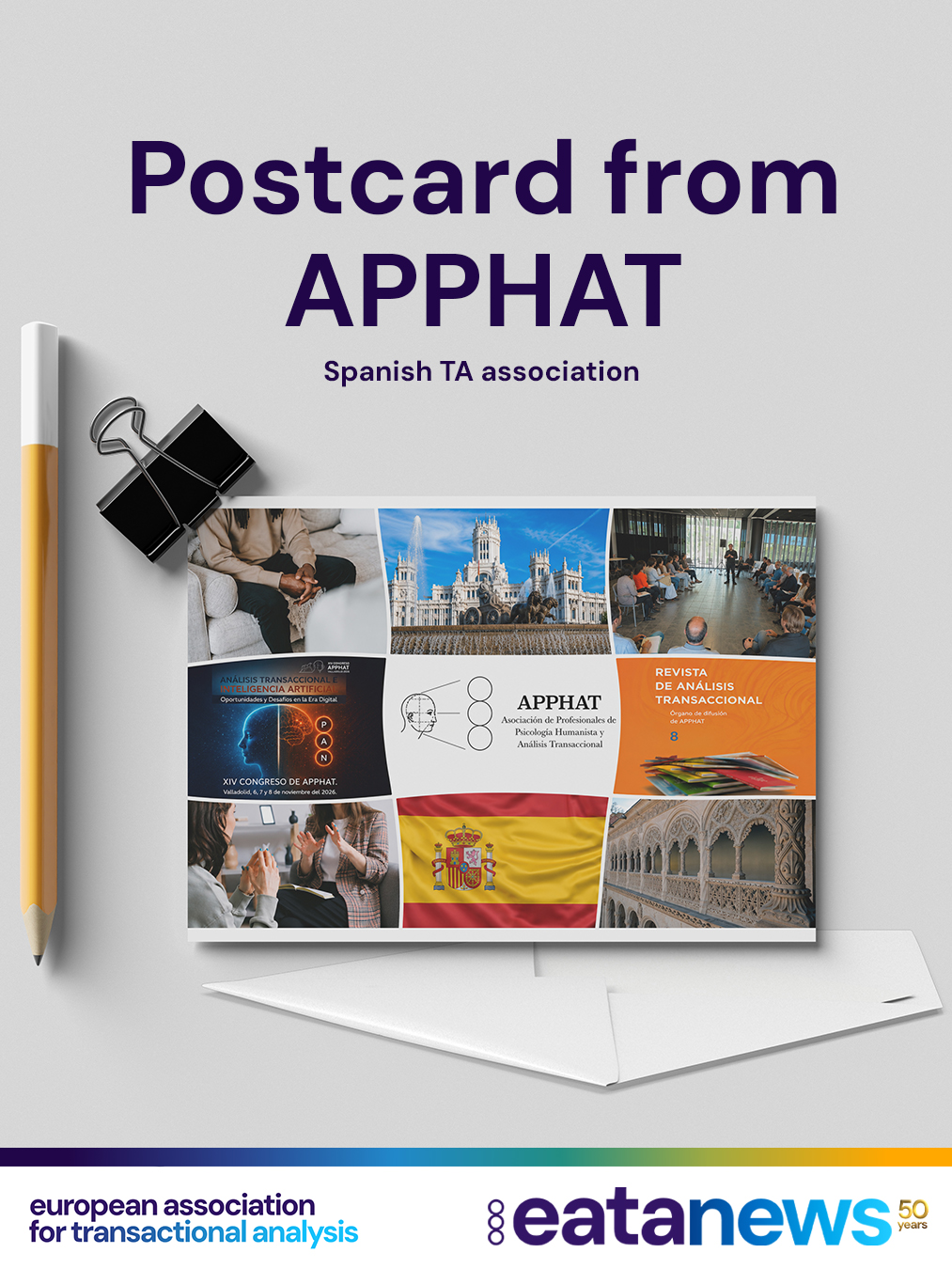
Taking up the baton from IFAT, we are pleased to report that APPHAT was founded in April 2000 by a group of professionals who wished to participate in the EATA accreditation processes for Transactional Analysts. Over the course of this quarter-century, our association has undergone various phases of growth and consolidation—experiencing both peaks and crises—that have led us to a state of maturity and stability.
Our association holds a biennial national congress that alternates with a biennial professional conference; the latter focuses primarily on facilitating in-person interaction among members and bringing together professionals from various fields where Transactional Analysis is applied.
This year, our Association will hold its 14th National Congress in Valladolid on November 6, 7, and 8, under the theme “Transactional Analysis and Artificial Intelligence: Opportunities and Challenges of the Digital Age.”
Our association has a scientific journal that, over the years, has published several volumes on the theory and practice of Transactional Analysis, featuring articles by various well-known international authors.
We are currently developing a process to digitise our scientific journal and offer its content in Spanish free of charge to Spanish-speaking readers around the world.
Our association occasionally organises webinars on critical aspects of Transactional Analysis for interested individuals, whether from within our organisation or from other fields.
Our organisation has a committed group of researchers who, over the past six years, have published eight articles on the efficacy, effectiveness, and efficiency of Transactional Analysis. This group was formed to address a problem that arose in 2018.
On November 14, 2018, the Spanish Ministers of Science and Health presented a “Plan for the Protection of Health against Pseudotherapies,” which consisted of 20 points. Among these measures, an assessment report on pseudotherapies would be conducted through the Spanish Network of Health Technology Assessment Agencies and Services of the National Health System. Transactional Analysis was included in the relation of Pseudotherapies. Royal Decree 1277/2003 would also be amended to eliminate “pseudotherapies” from healthcare centres and prohibit their practice and teaching in both the public and private sectors. The objective was to raise public awareness about the harmful effects of pseudotherapies and the inappropriate referrals to centres with purported healthcare purposes, as well as to eliminate the use of pseudotherapies lacking scientific evidence in public and private healthcare centres and services, to prevent the substitution of therapies with proven scientific evidence by pseudotherapies.
Our research group began periodically, lists of RCTs on the efficacy of Transactional Analysis that met the criteria requested by the Government Plan and different kind of evidences about efficacy, effectiveness and efficiency of Transactional Analysis. In total, more than 80 reports addressed to various government bodies.
I am pleased to inform you that, after 8 years of sending reports to the Health authorities, we have been removed from the lists of “Pseudotherapies” and subsequently from the list of “Potentially Evaluable Techniques” in the “Government Plan for the Protection of Health against Pseudotherapies.” Transactional Analysis was listed in both, and was at risk of having its practice and teaching prohibited in both public and private teaching and assistance facilities.
We have to continue with a line of work aimed at finally being included in the Clinical Protocols and Clinical Guides prepared and updated by organizations such as the APA, or the NICE, or those commissioned by Governments to Groups of Experts.